
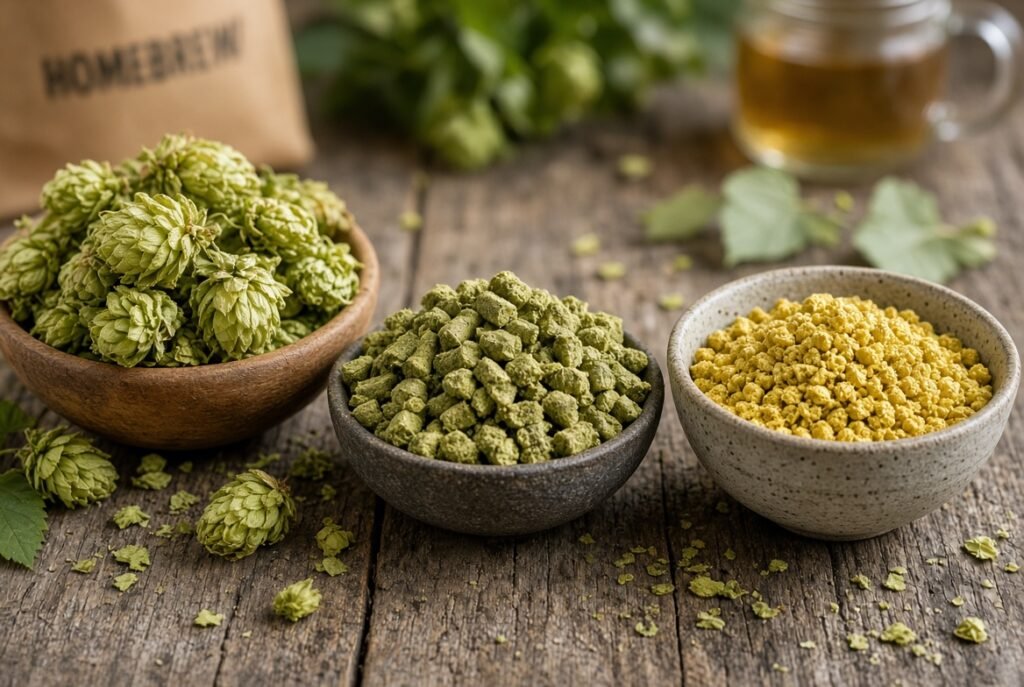
I know a few homebrewers who swear by whole hop cones. I know two who buy root cuttings, called hop rhizomes, and grow their own hops. I am not quite that sophisticated, I am a humble extract brewer who mostly utilizes hop pellets. Go to most of our top-rated online beer stores, and you can find up to 6 different forms of hops available.
Homebrewers mainly work with a few standard hop forms, plus some specialized products.
The most common by far are pellets (mostly T-90), followed by whole-leaf (cone) hops. Others include plugs, wet/fresh hops, Cryo (or similar concentrated) pellets, and extracts.
Here’s a practical breakdown of the main options, with typical pros and cons for homebrewing:
1. Whole Cone / Whole Leaf Hops (Dried)
Dried hop cones, minimally processed.
Pros:
- Least processed, so many brewers feel they retain more delicate aroma and “fresh” character.
- Easy to contain in a hop bag or spider and remove from the kettle (they form a natural filter bed that can help with trub).
- Traditional feel; preferred by some for classic English, German, or cask styles.
Cons:
- Bulkier and take up more freezer space.
- Shorter shelf life once opened (more surface area → faster oxidation).
- Lower utilization (roughly 10–15% less bitterness extraction than pellets in most cases).
- Absorb more wort, leading to slightly lower yield.
- Can be harder to measure precisely in small amounts.
Best for: Late additions, dry hopping when you want maximum aroma complexity, or traditional styles. Store sealed and frozen.
2. Hop Pellets (Mostly T-90)
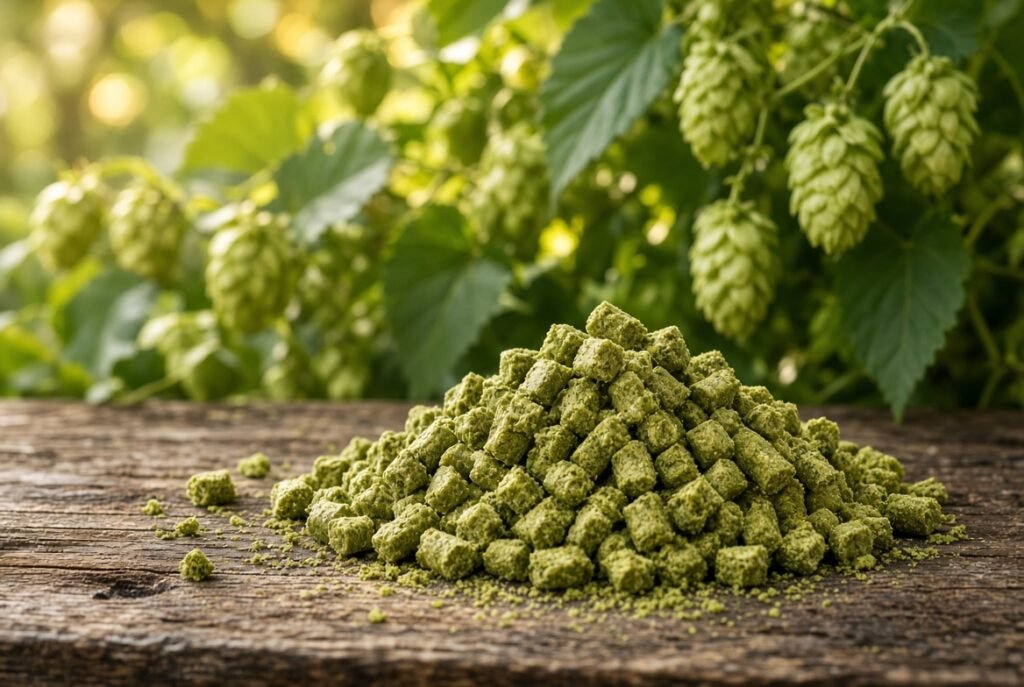
Ground hops compressed into small cylinders. T-90 is the standard (retains most of the original cone material). T-45 is more concentrated (more vegetative material removed).
Pros:
- Most widely available and affordable.
- Compact and store well in the freezer (lower oxidation rate).
- Easy to weigh and measure accurately for small batches.
- Higher utilization (about 10–15% better bitterness extraction than whole leaf).
- Works for both bittering and aroma additions.
Cons:
- Break down into fine particles (“hop sludge”) that can clog equipment if not contained (use a bag, spider, or good whirlpool/filter).
- Some volatile aromatics can be lost in processing compared with very fresh whole cones.
- Produce more fine trub.
Verdict: The default choice for most homebrewers for everyday use. Excellent all-around performance.
3. Hop Plugs
Dried whole cones compressed into larger puck-like cylinders (often ~½ oz). Less common than they used to be.
Pros:
- Better storage than loose whole leaf (less surface area).
- Expand in the kettle and behave somewhat like whole cones.
- Convenient pre-measured units.
Cons:
- Harder to break into partial amounts.
- Still bulkier than pellets and absorb more wort.
- Availability is limited compared with pellets.
Best for: Brewers who like whole-cone character but want slightly better storage.
4. Fresh / Wet Hops
Undried hops, used within days of harvest (typically late summer/fall).
Pros:
- Intense, unique fresh aroma and flavor that can’t be fully replicated with dried hops.
- Fun seasonal experience.
Cons:
- Extremely short shelf life (use within 1–3 days ideally).
- High water content means you need roughly 5–6× more by weight.
- Can introduce vegetal/grassy notes if boiled too long.
- Limited availability and logistics.
Best for: Special seasonal batches, mostly late additions or short boils. Not practical for year-round brewing.
5. Cryo Hops / Lupulin-Enriched Pellets
Concentrated pellets made by separating and concentrating the lupulin glands (where most resins and oils live). Roughly twice as potent in alpha acids and oils as standard T-90s, with much less leafy material.
Pros:
- Intense aroma and flavor with less vegetal/grassy character.
- Use roughly 40–50% of the weight of T-90 for similar impact.
- Less beer loss from absorption (especially helpful in heavy dry-hopping).
- Great for hazy IPAs, whirlpool, and dry-hop additions.
Cons:
- More expensive per ounce (though you use less, so cost can be similar or better).
- Can feel “thinner” or less complex if used as a 100% replacement—many brewers blend them with regular T-90 pellets.
- Not ideal for pure bittering (waste of the delicate oils).
Best for: Maximizing hop character in hop-forward beers while minimizing trub and beer loss.
6. Hop Extracts (CO₂ Extract, Isomerized Extracts, etc.)
Concentrated liquid resins or oils. CO₂ extracts are common for bittering; isomerized versions have the alpha acids already converted.
Pros:
- Extremely long shelf life.
- Precise dosing of bitterness with almost no trub or vegetative matter.
- High utilization and consistent results.
- Useful for adjusting bitterness post-boil or in large volumes.
Cons:
- Less aromatic complexity than whole or pellet hops.
- Can be harder to measure in very small homebrew amounts.
- More expensive and less “craft” feeling for many homebrewers.
- Primarily useful for bittering rather than full flavor/aroma contribution.
Best for: Clean bittering additions, consistency, or when you want to minimize hop material.
Hop Forms Quick Comparison
| Form | Storage | Utilization | Ease of Use | Aroma Character | Best For |
|---|---|---|---|---|---|
| Whole Leaf | Fair | Lower | Medium | Excellent (if fresh) | Traditional, dry hop |
| T-90 Pellets | Excellent | Higher | Excellent | Very good | Everyday brewing |
| Plugs | Good | Medium | Medium | Good | Whole-cone fans |
| Wet/Fresh | Poor (days) | Low | Low | Intense/unique | Seasonal specialty |
| Cryo / Concentrated | Excellent | Very high | Good | Intense, clean | Heavy dry hopping, IPAs |
| Extracts | Excellent | Highest | Good | Limited | Precise bittering |
Practical recommendation for most homebrewers: Start with T-90 pellets. They’re convenient, widely available, store well, and perform reliably for both bitterness and aroma. Use whole-leaf when you specifically want the traditional character or easier filtration. Experiment with Cryo or extracts once you’re comfortable and want to optimize hop-forward beers or reduce losses.
All hop forms should be stored cold (freezer is ideal) in oxygen-barrier packaging to preserve alpha acids and oils. Freshness matters more than form in most cases.
Leave a Reply