
Understanding Standard Reference Method (SRM) to Measure a Beer’s Color
For most beer drinkers, they may know whether they prefer lighter or darker brews, but the exact shade remains unimportant. However, behind the scenes, brewers have a deep appreciation for the intricacies of beer color.
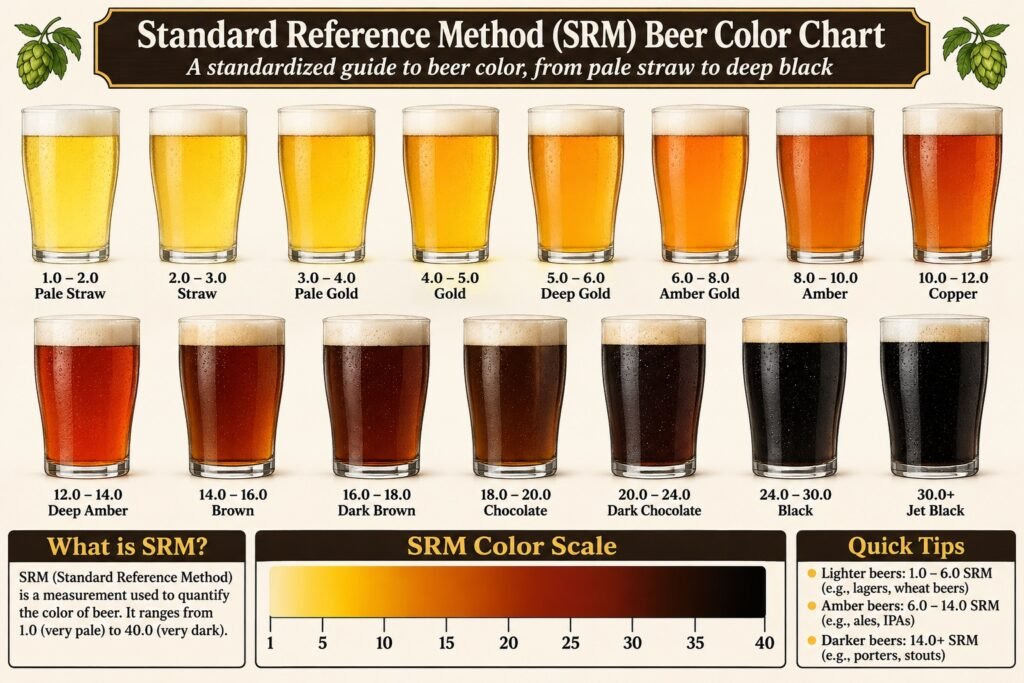
In its simplest terms, SRM, or Standard Reference Method, is a measurement used to quantify the color of beer. It ranges from 1.0 (very pale) to 40.0 (very dark).
I explain it below, but the SRM scale actually goes up to 80. Beer colors, however, do not exceed 40. While equipment can detect ranges from 1 to 80, the human eye can’t perceive darkness beyond 40. Maybe that’s TMI, but I was intrigued.
The details are fascinating to this beer nerd, but you should understand that the recipes we provide are estimating the SRM. In fact, the vast majority of micro-breweries rely on brewing software to estimate the SRM of any particular brew during recipe formulation. They then compare it visually to the final product. Buying and maintaining the required equipment is simply not a practical need.
Unraveling the Standard Reference Method (SRM)
Among beer recipe ingredients, grains play a particularly significant role in the color. It makes sense since they are the major ingredient for making beer.
In their raw, unroasted state, grains tend to impart a pale yellow color to the beer. But as they undergo roasting at higher temperatures and for longer durations, their contribution darkens considerably.
To accurately measure the color of beer, the Standard Reference Method (SRM) proves to be an industry-accepted tool. The SRM scale is widely adopted in the United States and beyond for precisely this purpose. Developed by the American Society of Brewing Chemists in 1950, it stands as the scientific gold standard for beer color identification.
How SRM Works
Sophisticated laboratory equipment and techniques are employed to calculate the SRM of a beer sample and determine the contribution of each grain to the overall color. In this process, a small sample of beer is subjected to light, and the drop in intensity resulting from absorption is recorded and analyzed.
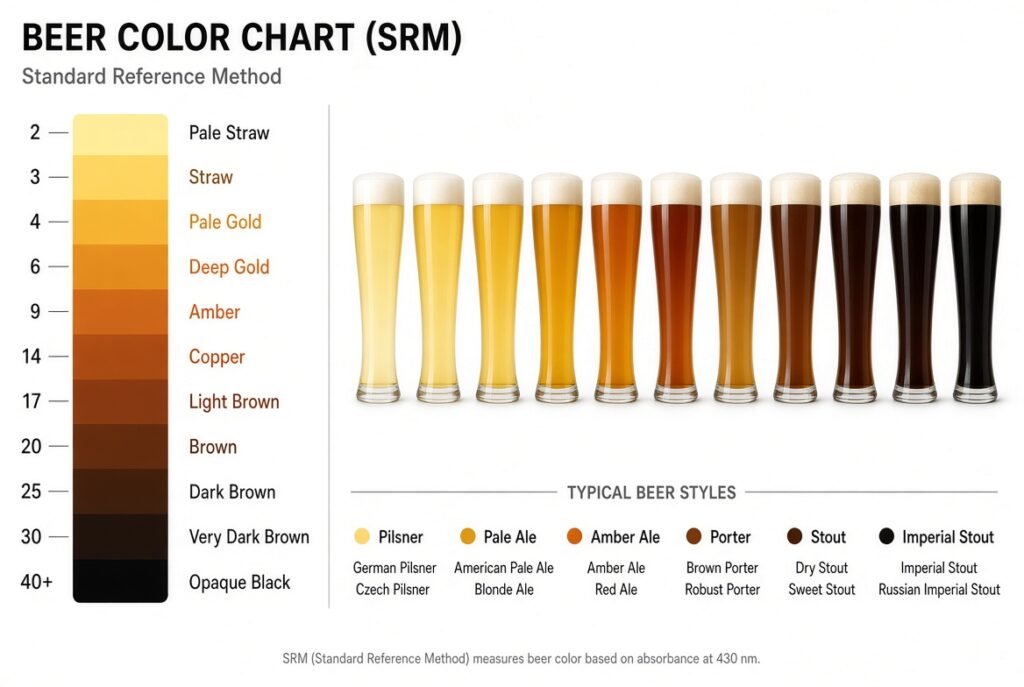
The SRM relies on a spectrophotometer, which measures the color of the beer sample using monochromatic light at a wavelength of 430 nanometers. A 1/2-inch cell is employed, ensuring accurate readings.
Understanding the SRM Scale
The SRM scale assigns numerical values to different beer colors, allowing brewers and enthusiasts to discuss and compare shades with precision. The scale ranges from 2 to 80, with each value corresponding to a specific color intensity.
Reasons for SRM Limitations
While the SRM scale technically extends up to 80, most beer descriptions and menus rarely venture beyond an SRM of 40. This limitation arises from the inherent limitations of the human eye in differentiating shades of black. A beer with a very dark brown color can appear strikingly similar to one that is pitch black, making it virtually indistinguishable from an appearance perspective.
TECHNICAL STUFF
SRM quantifies color density (how much light is absorbed), not exact hue. A beer at the same SRM can lean more red, brown, or golden depending on malts. Charts are visual aids—lab measurement or recipe calculators (e.g., using MCU and Morey equation) give precise numbers. For judging, the official BJCP Color Guide is calibrated for specific path lengths and lighting.
Standard Reference Method Beer Color Chart
Leave a Reply